Back to blog
#33 - A $2 Trillion Deal, Gold Soars, and the Secret Behind Procurement That Works
Edoardo Arbizzi

🌎 Global Outlook
🤝 India-EU: the $2 trillion marriage reshaping supply chains
After 20 years of stop-and-go negotiations, India and the European Union have finally concluded their Free Trade Agreement. Announced on January 27, 2026, this deal links 27 European states with one of the fastest-growing economies in the world. For Procurement teams, it means completely rethinking sourcing strategies.
The timing is perfect (or desperate). While the Trump administration threatens 50% tariffs on Indian products and continues its trade war with Europe, New Delhi and Brussels have decided to find more reliable alternatives. “This agreement will accelerate trade decoupling from unreliable partners, reducing vulnerabilities to on-again-off-again tariffs and the weaponization of supply chains,” Alex Capri of the National University of Singapore told the BBC.
For Brussels, India is the alternative to China. For New Delhi, the EU is a stable market after the collapse of negotiations with Washington. For European CPOs, it is the opportunity to diversify sourcing while reducing dependence on suppliers exposed to high geopolitical risk.
The tariffs that change the game:
Luxury cars: from 70-110% down to 40% (for vehicles above €15,000, with a maximum quota of 200,000 units per year)
Electric vehicles: tariffs unchanged for 5 years (to protect the Indian domestic market)
Textiles and jewelry: tariffs almost eliminated, restoring competitiveness lost in 2023
Wine and spirits: gradual reduction over several years (UK-India model)
In exchange, India negotiated fewer restrictions on steel exports and the restoration of GSP (Generalised System of Preferences) benefits. For Procurement managers sourcing Indian steel, this means more predictable costs and less bureaucracy.
But be careful: non-tariff barriers are the real problem.
Tariffs are falling, but Procurement teams still have to deal with significant regulatory obstacles:
CBAM (Carbon Border Adjustment Mechanism): the European carbon tax represents a huge challenge. Ajay Srivastava (GTRI) warns that CBAM “effectively functions as a new border tax on Indian exports,” hitting SMEs especially hard with high compliance costs. Procurement implication: CBAM compliance costs must be included in TCO (Total Cost of Ownership) when evaluating Indian suppliers.
Intellectual property: the EU is pushing for stricter standards on patents and data protection. This is a critical issue for those buying pharmaceuticals and technology from India, where IP regulations have historically been more flexible.
The lesson for Procurement: falling tariffs are not the whole story. CPOs must reassess Indian suppliers by considering the real Landed Cost of Goods Sold, including CBAM and IP compliance. With implementation expected in 2027, there is time to review sourcing strategies and diversify against US-China volatility.
But be careful: non-tariff barriers could wipe out the advantages of lower tariffs if they are not properly calculated in TCO.
🔗 Sources: Al Jazeera, Yahoo! Finance, Procurement Magazine
💰 Gold at $5,000: electronics Procurement in chaos
Gold has surpassed $5,000 per ounce for the first time in history. For investors, it is a celebration. For Procurement managers, it is a nightmare. What until yesterday was “just” a raw material in the Bill of Materials has now become a financial asset shaking budgets.
For those buying connectors, cables, aerospace plating, or medical components, this is a material cost shock that is forcing contract renegotiations overnight.
Natasha Kaneva, Head of the Global Commodities Strategy team at J.P. Morgan, had forecast this scenario at the end of 2025, but it arrived six months early. The bank now expects $5,055/oz in Q4 2026, rising toward $5,400/oz by the end of 2027. Translation: prepare for the worst.
Suppliers are bombarding teams with cost pass-through requests. Fixed-price contracts signed six months ago? They are eroding everyone’s margins, creating tension across the supply chain. Category managers and CPOs must explain to the CFO why the materials budget exploded by 30% in a single quarter, and it is not a pleasant conversation.
The immediate response has been to activate hedging through forward contracts and dynamic pricing clauses.
Those who invested in AI-driven analytics are already seeing the benefits: real-time scenario planning, supplier risk assessment, and rapid response capability. Everyone else is improvising with Excel and prayers.
An interesting trend is emerging: circular Procurement is suddenly accelerating. Recovering e-waste and reclaiming precious metals becomes attractive when gold is worth $5,000 an ounce. Companies that previously ignored component recycling are now building structured reverse logistics programs. When the numbers change, priorities change too.
As if that were not enough, the mining sector is consolidating aggressively. Zijin Gold has just acquired Allied Gold for $4.01 billion. For Procurement teams, this means only one thing: fewer suppliers, more concentrated pricing power, and less room to negotiate.
The lesson for Procurement is brutally simple: those who respond quickly win, those who wait lose. That means mapping gold exposure across every spend category, coordinating hedging strategies with finance and treasury, renegotiating contracts with transparent clauses, and investing heavily in recycling. But it also means collaborating with R&D to reduce gold content in products wherever technically possible. Some companies are already exploring alternative materials for connectors and plating, with promising results.
The real question is: is your team agile enough to adapt, or are you still waiting for prices to “go back to normal”?
🔗 Sources: Procurement Magazine, J.P. Morgan Global Research
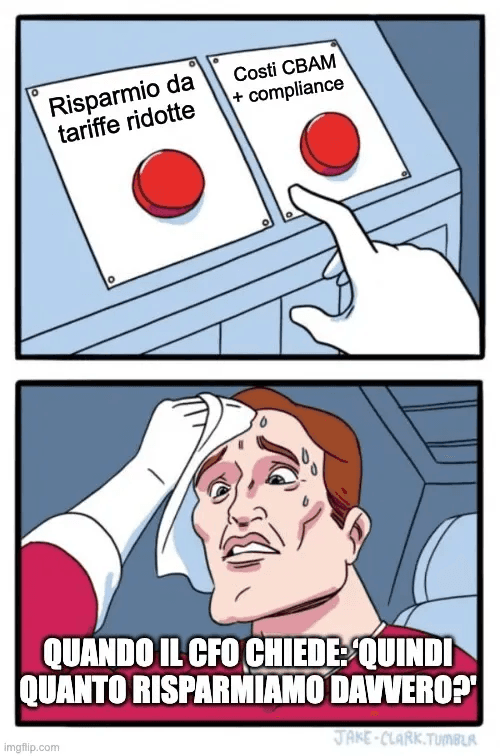
🖼️ Meme of the day
🎙 Compri Bene Podcast
🤝 Procurement Is About People — with Francesco Maffioli (Director of Purchasing - Carrier)
In the new episode, we talk with Francesco Maffioli, who has spent 25 years in Procurement across very different sectors before taking the lead in purchasing at a major multinational company.
He explains how to integrate global and regional teams, how internal champions accelerate the adoption of new technologies, and why Procurement must be involved in new product development from day one.
🎧 Listen to the interview! ⬇️
💬 Your opinion matters!
Do you have feedback to share?
Write to us 📨 at compribene@compri.ai and let us know what you think! We are here to listen and make Compri Bene increasingly useful and interesting. ⚡
The Compri Bene team
Join compri,
10X your procurement team.
compri uses AI to make your procurement experience easier, faster and smarter. Get in touch to know more