Back to blog
#36 - Aluminum and tariffs in full turmoil, oil reignites inflation and LEGO teaches net zero Procurement
Edoardo Arbizzi
🌎 Global View
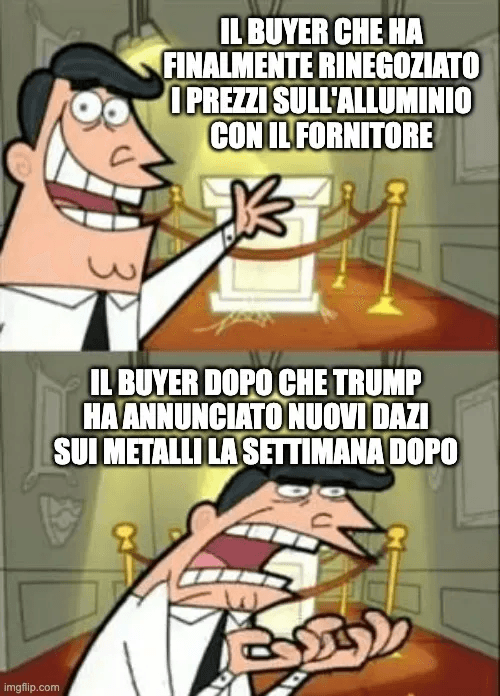
🥫⚖️ Aluminum and tinplate: 50 percent tariffs, Supreme Court ruling and now war
If in the past two weeks you have received price adjustment requests on metal materials, you are not alone. The landscape has become particularly complex, and it is worth understanding what actually happened.
First chapter: the United States Supreme Court ruling of February 20, 2026. The Trump administration saw its reciprocal tariffs imposed under the International Emergency Economic Powers Act struck down. The news circulated globally, but it also created confusion. The key fact: Section 232 tariffs on steel and aluminum were not affected. They remain in force at 50 percent, as they have since June 2025. No relief for those sourcing metal packaging, aluminum components or steel inputs.
Second chapter: speculation and reversals. In mid February the Financial Times reported that the administration was considering a selective easing of metal tariffs after a New York Fed study showed that in 2025 almost 90 percent of tariff costs were borne by US companies and consumers rather than foreign exporters. Markets reacted immediately. The aluminum contract on the London Metal Exchange dropped almost 1 percent in a single session, with intraday losses exceeding 2.7 percent. The White House denied the report, and for now the 50 percent tariffs remain.
The practical result is visible in premiums. The Midwest Premium, the surcharge US buyers pay on aluminum compared to global market prices, surpassed $1 per pound for the first time at the end of January. The Can Manufacturers Institute has been explicit: the industry relies on imported tinplate for nearly 80 percent of its needs and expects stronger price increases in 2026 than in 2025.
Third chapter: war. The conflict in the Middle East added another layer of uncertainty. In 2025 the region accounted for around 21 percent of US primary aluminum imports according to the Aluminum Association. Geopolitical tensions now complicate trade routes and increase costs.
For Procurement this is the moment to review metal supply contracts. Without commodity indexed price escalation clauses, expect unilateral renegotiation requests. If you have such clauses, use them as a tool for transparent dialogue rather than as a defensive shield. If your sector relies on tin or aluminum packaging, the effect will likely become visible at the retail shelf. Canned food categories were already among those with the sharpest price increases at the end of 2025.
🔗 Sources: Supply Chain Dive, Informatore
🛢️📈 Oil shock is not only about fuel: how energy stress hits the entire supply chain
Brent exceeded $100 per barrel on March 12 for the first time since 2022. Since the beginning of the year prices have risen by nearly 76 percent. The direct trigger is the Hormuz crisis. According to the International Energy Agency, this represents the largest supply disruption in the history of the global oil market, with world crude production in March down by 8 million barrels per day, around 7.5 percent of global supply.
Stopping at higher gasoline prices would be a mistake. For those working in Procurement, the shock transmits across three levels.
Level one: direct transport and energy costs. This is the most visible layer. In Italy between March 1 and March 9 diesel prices rose by 25.8 percent, while Brent increased by 24 percent over the same period. The additional 1.8 percent cannot be explained purely by crude prices. According to an Unimpresa analysis it corresponds to an extra 8 to 20 cents per liter added beyond what real costs would justify. For companies heavily dependent on road transport, the impact is already reflected in invoices.
Level two: everything that uses oil as an input. This is the less discussed but more structural risk. The Strait of Hormuz does not only affect crude. It also affects sulfur, essential for fertilizers, semiconductors, nickel and copper. Around half of globally seaborne sulfur passes through that corridor. Last week sulfur prices in China increased by 15 percent. Urea, one of the most widely used fertilizers, rose in some markets from $485 to $665 per ton within days. For buyers of plastic components, flexible packaging, fertilizers or chemical materials, quotations received ten days ago may already be outdated.
Level three: macro effects on rates and credit. This is slower but potentially more durable. According to Oxford Economics, current energy prices imply European inflation 0.5 to 0.6 percentage points above February forecasts. Markets expect the ECB may need to raise rates not once but twice by the end of 2026. Translation: more expensive credit, costlier supply chain financing and smaller suppliers under cash pressure precisely when costs are rising.
The scenario remains highly fluid. This week Trump declared that the war would end very soon, triggering a negative Brent swing of more than $30 in 24 hours, followed by a rebound. Barclays analysts suggest prices could climb well above $120 if the situation persists for several more weeks.
Three concrete actions to take now:
Map exposure to petrochemicals within your supplier base, not only direct energy consumption but also key inputs with high oil derivative intensity
Review price escalation clauses in contracts to build transparent mechanisms that prevent emergency renegotiations
Monitor liquidity of smaller suppliers, since during energy stress small and medium enterprises are often the first to face cash strain and supplier distress is a continuity risk, not only a pricing issue
🔗 Sources: Ansa, PBS, Euronews, Investimenti Magazine, Liberacr
Meme of the day
♻️ Sustainability Focus
LEGO and net zero Procurement: brick by brick
Amid tariffs, $100 oil and surcharges, it is worth looking at a company building resilience in the most structural way possible by turning suppliers into climate partners. LEGO Group is a case study Procurement professionals should not ignore, not because of grand ideals but because it offers a replicable operating model.
The starting point is brutally honest: more than 99 percent of LEGO’s CO2 emissions originate outside its own operations, in its supplier network. Scope 3, the hardest category to manage. The response was not a generic commitment or ESG report. LEGO launched a Supplier Sustainability Programme with short term emission reduction targets for 2026 and 2028 covering its 52 highest impact suppliers, mandatory carbon accounting with annual reporting, and a crucial detail: access to a dedicated sustainability expert team made available to suppliers that require support.
The numbers behind the commitment are tangible. Environmental initiative spending increased by 60 percent in 2023. Solar capacity in owned facilities grew by 61 percent. By 2030 half of the materials used in bricks must come from sustainable sources, including bioplastics derived from sugarcane and transparent bricks produced from recycled marble. COO Carsten Rasmussen has been explicit: sustainability is a license to operate and a requirement in how we conduct business, including how we select suppliers.
The link with current events is clear. While oil exceeds $100 and energy costs surge, the LEGO model shows the other side of the equation. Companies that have already invested in the energy transition of their suppliers are structurally less exposed to commodity shocks. A supplier that has shifted to renewable energy is less vulnerable to Brent spikes. Sustainability is not only ESG positioning. It is also a hedge against commodity risk.
The lesson for small and medium enterprises is pragmatic. You do not need LEGO’s scale to start. The first step is an energy exposure analysis of your supplier base. Which suppliers depend most on oil derivatives? Which processes are highly energy intensive? The same mapping required to manage today’s risk is also the foundation for building tomorrow’s sustainable supplier qualification program.
🔗 Sources: Procurement Magazine (1), Procurement Magazine (2), LEGO
💬 Your opinion matters
Do you have feedback to share?
Write to us at compribene@compri.ai and let us know what you think. We are here to listen and make Compri Bene increasingly useful and relevant. ⚡
Compri Bene is the newsletter by compri.ai that gives Procurement teams superpowers, with the latest news from the world of sourcing, from regulatory changes to industry best practices.
Team Compri
Join compri,
10X your procurement team.
compri uses AI to make your procurement experience easier, faster and smarter. Get in touch to know more