Back to blog
#37 - Persian Gulf and supply chains, critical minerals and the EU-USA deal that changes the rules
Edoardo Arbizzi
🌎 Global View
💣 Persian Gulf: global supply chains are still under pressure
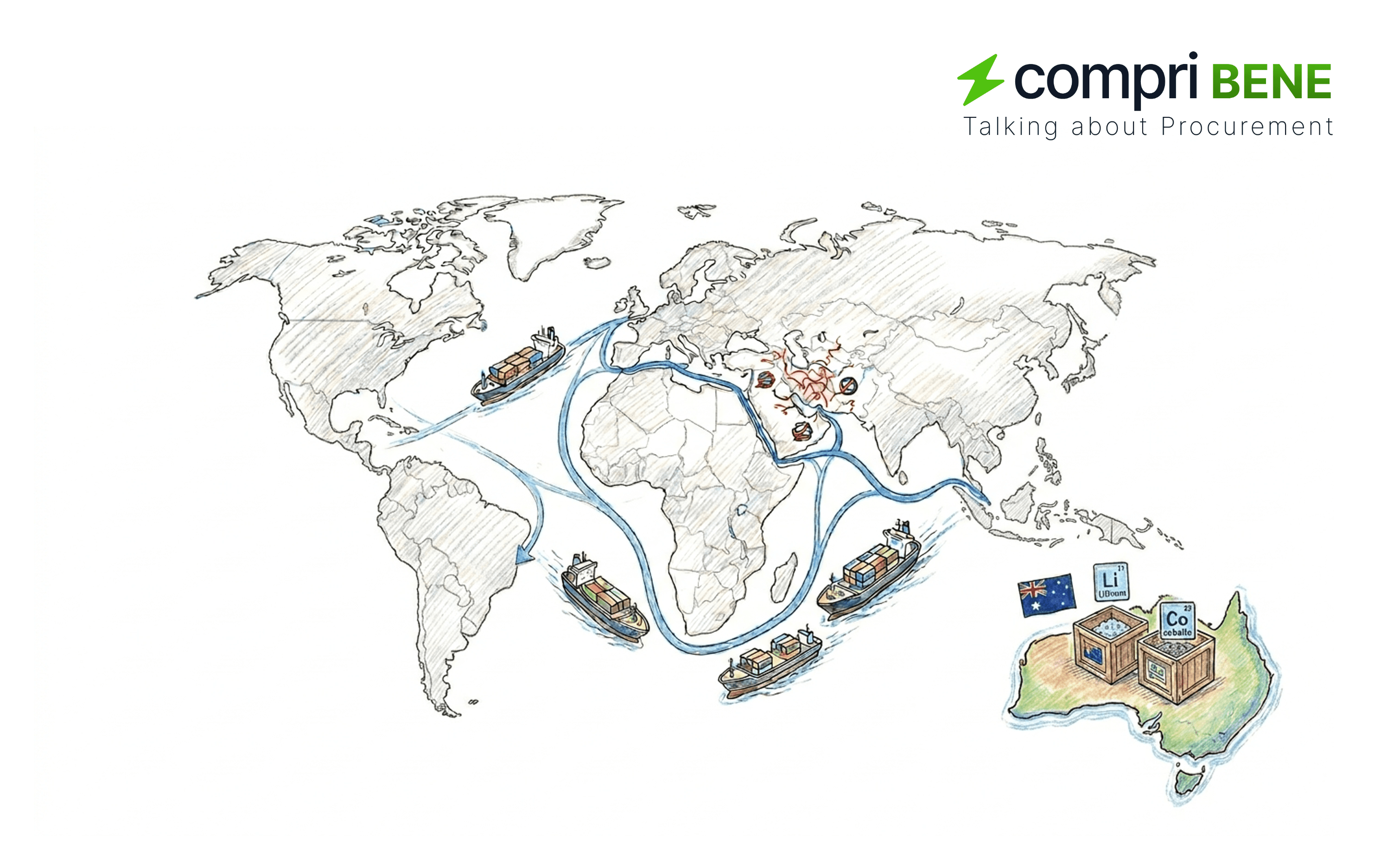
The conflict in Iran is adding a new layer of chaos to an already strained global supply chain. The US and Israeli attack, and the subsequent retaliatory actions, are impacting delivery times, supply availability, maritime routes and - very likely - corporate revenues.
The most critical point? The Strait of Hormuz. A blockage there would have enormous consequences for container traffic heading to Gulf ports. Any plan to return container shipping to the Red Sea in 2026 is now frozen: those who were rerouting back from the Cape of Good Hope route are stopping again. Rerouting around Africa means adding up to two weeks to transit times.
The structural problem is that many companies do not actually know where their risks lie. As Dean Alms of Aravo explains, it is not uncommon for a company to be unaware that its main supplier has 17 plants around the world, one of which is in the Middle East, and therefore cannot assess its own exposure until it is too late.
The Gartner data is stark: during a supply chain disruption, nearly two-thirds of companies expect revenue losses, with an average increase of 40% in cost-to-serve. And according to DP World, 38% of North American cargo owners lost at least $1 million in a single year due to supply chain instability.
The lesson for Procurement? Mapping the supply chain down to second- and third-tier suppliers is not a nice-to-have. It is pure operational survival.
🔗 Sources: ISM (1), ISM (2), NRF
🏛️ Public Procurement and the elephant in the room: corruption and rigged tenders
An investigation by the Financial Times published this week tells two stories worth knowing, not because they directly involve SMEs, but because they show what happens when Procurement stops being an independent function and becomes a tool of power.
The Hungary case: nearly 350,000 public contracts were analysed from 2010 to late 2025. Result: 13 men close to Viktor Orbán's inner circle won over €28 billion in government tenders - a 15-fold increase compared to the five years before his election. These companies won 69% of contracts through single-bid procedures (with no competition), against a national average of 29%. The EU has frozen approximately €18 billion in funds owed to Hungary for this reason. An expert from the EU anti-fraud authority commented: the statistics indicate a distortion of competitive procedures, even though the tenders formally complied with the rules.
The South Africa case: national police commissioner Fannie Masemola was charged with corruption related to a 360 million rand (~$20M) contract for medical services for 180,000 officers. The contract was subsequently cancelled because, among other issues, the supplier's IT system was incompatible with the police mainframe. Comment from an investigative journalist: "It is embarrassing that the police awarded a tender to a man who was already under investigation for procurement fraud by the same organisation that awarded the tender."
Why does this matter to those working in private Procurement? Because both cases are a reminder that the separation between those who define sourcing strategy and those who evaluate suppliers is the only mechanism that keeps Procurement credible. Every time this boundary blurs - in the public sector as in the private - costs explode, quality falls and controls always arrive too late.
🔗 Sources: HVYLYA, Daily Maverick, Mail Guardian
♻️ Sustainability Focus
🔋 Critical minerals: the new frontier of sustainable Procurement
Lithium, cobalt, rare earths, copper. Already talked about as a ticking time bomb for supply chains. This week the situation took a concrete step forward.
On 19 March, the US and Japan signed a Critical Minerals Action Plan aimed at reshaping the entire global market for these raw materials. The agreement goes well beyond the two countries: the stated goal is to build a plurilateral agreement with all "aligned" partners to counter Chinese dominance. Beijing currently controls 60% of global rare earth mining and up to 90% of refining capacity, and does not hesitate to use this control as a geopolitical lever.
The most interesting (and revolutionary) mechanism? Border-adjusted price floors: minimum prices guaranteed through tariff mechanisms among member countries, to make it economically viable to extract and refine minerals in allied nations even when China attempts to lower market prices to eliminate competition. An idea that breaks with decades of pure free-market logic, but one that reflects the new paradigm: supply security is worth as much as - or more than - cost optimisation.
For Procurement, this translates into two practical implications:
New dual sourcing scenarios: those already working on diversification strategies for rare earths and battery metals have a significant advantage over those still dependent on a single Chinese supplier.
More predictable long-term costs: if the mechanism works, it will reduce the price volatility that currently makes it nearly impossible to plan spend in these categories.
The EU-USA deal completes the picture. On 26 March, the European Parliament approved the so-called Turnberry Agreement (signed in Scotland in July 2025) with 417 votes in favour. The deal cuts EU tariffs on American industrial goods to zero, in exchange for a 15% cap on US duties on European goods. The EU inserted strong safeguards: a sunset clause expiring in 2028 and a sunrise clause tying tariff reductions to US compliance with its commitments. A key detail for Procurement: the agreement guarantees European companies access to Australian critical minerals at the same price as local competitors - a point Von der Leyen presented as a non-negotiable condition.
The process is not yet complete: national governments must still negotiate the final form of the legislation, with the first trilogue scheduled for 13 April.
🔗 Sources: Supply Chain Dive (1), Supply Chain Dive (2), Euronews, Metal Tech News
Team Compri
Join compri,
10X your procurement team.
compri uses AI to make your procurement experience easier, faster and smarter. Get in touch to know more