Back to blog
#38 - Hormuz Toll in Bitcoin, Hasbro Hacked and China's Supply Chain Crackdown
Edoardo Arbizzi
🌎 Global View
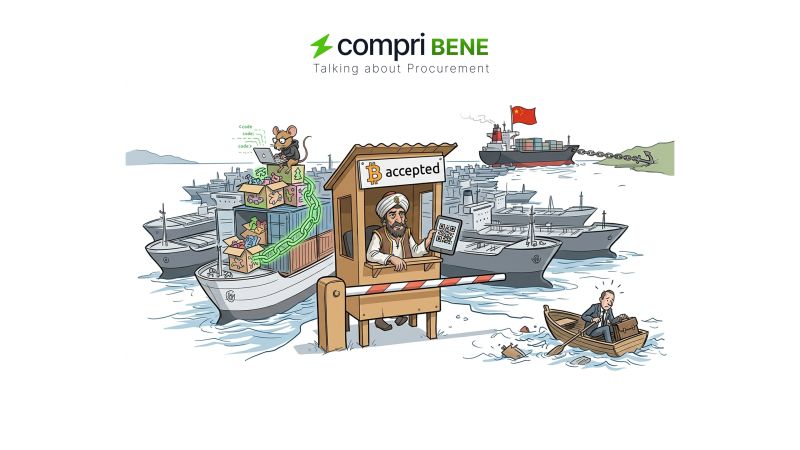
⛽ The Strait of Hormuz becomes a toll booth: $2 million per ship, payable in Bitcoin
No, this is not the plot of a dystopian film. Iran is literally charging a toll to ships crossing the Strait of Hormuz, and accepting payment in Chinese yuan, Bitcoin and USDT stablecoins.
The facts: following the US-Israel attack on Iran on 28 February, Iran blocked the Strait through which 20% of the world's oil and 20% of global LNG normally passed. Traffic collapsed by 95%: from 100-120 ships per day to fewer than 10. On 8 April a temporary ceasefire was announced, but the Strait remains "effectively closed", with Iran deciding who passes, who does not, and at what price.
What does it cost to get through? Up to $2 million per tanker, according to analysts. The IRGC (Islamic Revolutionary Guard Corps) accepts payment in yuan or crypto to circumvent US sanctions. TRM Labs confirms transactions in Bitcoin and potentially USDT, although the scale of on-chain payments remains unclear.
The impact on supply chains is devastating: the Persian Gulf accounts for 30-35% of global urea exports and 20-30% of ammonia, critical inputs for world agriculture. The GEP supply chain volatility index shot up to 0.57 in March, the highest level in three years. Brent crude crossed $114 per barrel. Gasoline prices in the US rose 40%.
And even if the ceasefire holds, analysts estimate it will take until at least July to return to normality: 400 loaded tankers are waiting to exit the Gulf, but only 100 empty vessels are ready to enter. It is like a motorway gridlock where all the cars are heading in the same direction.
For Procurement Managers: if your supply chain depends on energy, fertilisers, petrochemicals or LNG from the Gulf, the time to activate alternative suppliers was yesterday. Shipping costs on Gulf-linked routes already carry a War Risk Surcharge of up to $1,500 per container.
🔗 Sources: CNBC, CNN, Fortune, PrNewsWire
🇨🇳 China launches its "anti-foreign supply chain law": here is why you should be concerned
On 7 April, the Chinese State Council published the "Regulation on Industrial and Supply Chain Security", 18 articles that came into force immediately, with no transition period. Translation: Beijing has just turned supply chains into a matter of national security.
What does the law say? Chinese authorities will be able to launch security investigations against foreign governments, organisations and individuals that adopt "discriminatory bans" or take actions that harm the security of Chinese supply chains. Possible countermeasures range from trade and investment restrictions to limitations on market access.
Why is this different from previous laws? China already had tools such as export controls and anti-sanctions legislation, but they were fragmented. This regulation is the first unified framework specifically targeting supply chain security. As Cameron Johnson of Tidalwave Solutions explains, this law "formalises China's shift from viewing supply chains as purely economic to treating them as a national security asset."
The most concerning aspect for multinationals: the law does not only target foreign government actions. It could extend to commercial conduct that impacts the stability of Chinese supply chains. A European company that decides to diversify away from China could theoretically come under regulatory scrutiny.
For European Procurement Managers: it is time for a serious assessment. How much of your supply chain runs through China? Which critical components depend on Chinese suppliers? And above all: do you have a Plan B if Beijing decides your diversification strategy is a "security threat"?
🔗 Sources: Supply Chain Brain, Morgan Lewis, geopolitechs
🔒 Curiosity
🎮 Hasbro hacked: when a cyberattack brings Monopoly, Transformers and Play-Doh to a standstill
Who would have thought hackers would target the maker of Monopoly? Yet on 28 March, Hasbro discovered unauthorised access to its systems and was forced to take part of its IT infrastructure offline. The result: weeks of delays on orders and shipments for one of the world's largest toy companies.
The story is an unsettling case of déjà vu: in 2025 it was Jaguar Land Rover that came under attack, five weeks of halted production, 5,000 suppliers affected, estimated damage of £1.9 billion to the British economy. The UK government had to guarantee a $1.5 billion bailout to prevent the automotive supply chain from collapsing.
The numbers tell the story: according to recent research, 61% of companies experienced a supply chain breach in the past year, and nearly a third reported operational disruptions or financial losses. In the Hasbro case, the Midway distribution centre in Georgia, recently opened to streamline logistics, found itself managing orders through emergency manual processes.
The pattern is always the same: hackers do not attack the fortress, they attack the weakest supplier. Mango was hit through a marketing vendor. Collins Aerospace through MUSE software. JLR through a contractor's Jira account. As one cybersecurity expert puts it: SMEs are the "soft underbelly" of the supply chain, with weaker defences and fewer dedicated security personnel.
The lesson? Cybersecurity is no longer just an IT problem — it is a Procurement problem too. If your critical supplier gets hacked, your production stops. Full stop. Time to include cybersecurity requirements in supply contracts and verify that your partners have business continuity plans worthy of the name.
🔗 Sources: Supply Chain Dive, Tech Crunch, Supply Chain Brain
Team Compri
Join compri,
10X your procurement team.
compri uses AI to make your procurement experience easier, faster and smarter. Get in touch to know more