Back to blog
#39 - "Made in Europe" vs China, drones reshaping military Procurement, and the AI chaos
Edoardo Arbizzi
🌎 Global Outlook
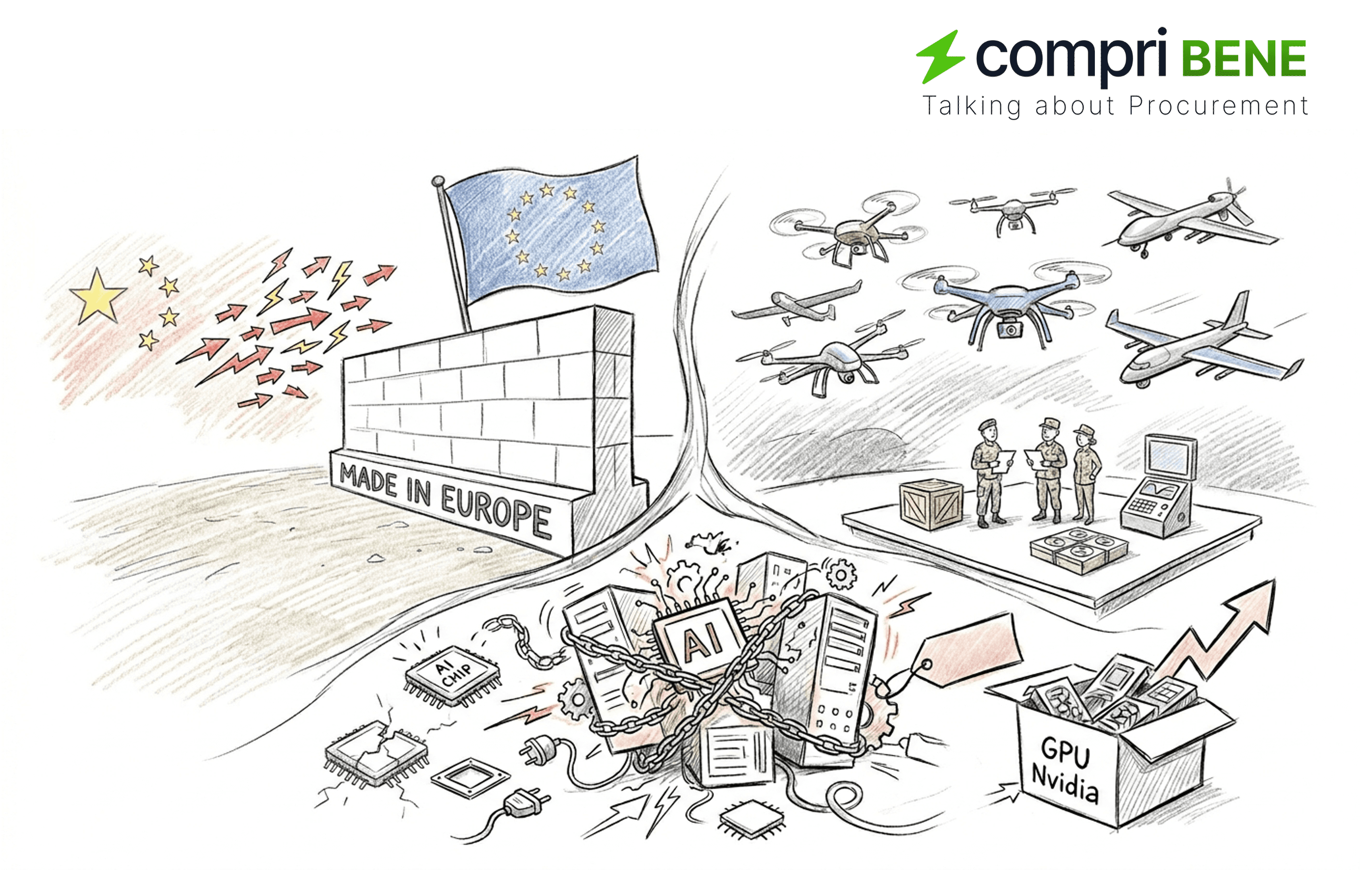
🇪🇺 "Made in Europe": Brussels builds the wall, Beijing threatens retaliation
The European Commission is moving forward with the Industrial Accelerator Act, already nicknamed the "Made in Europe law", and Beijing's reaction was swift: China's Ministry of Commerce announced "countermeasures" if Chinese companies are harmed.
The facts: the new law is the EU's most serious attempt to push back against high-tech Chinese imports. The goal is to raise manufacturing's share of EU GDP to 20% by 2035 (today it sits at 14.3%). The regulation will impose restrictions on foreign investments above 100 million euros in strategic sectors such as batteries and solar panels, when coming from countries that control more than 40% of global production.
For new investments, at least 50% of workers must be European, local companies must be involved in the manufacturing process, and foreign suppliers must transfer technological know-how to European partners. It's effectively a mirrored version of what China has imposed on Western multinationals for decades through mandatory joint ventures.
The numbers behind the crackdown are striking: according to the OECD, Chinese manufacturers receive subsidies between 3 and 9 times higher than those available to their rich-world counterparts. Meanwhile, while the US and China negotiate a trade truce, Beijing is trying to keep communication channels open with Europe, which remains a critical export market.
For Procurement Managers: if your company works with suppliers from China in strategic sectors, it's time to assess the impact. The law also includes restrictions on public procurement and could reshape automotive, renewable energy, and battery supply chains. Beijing argues that the law violates WTO principles and says it's open to dialogue, but the threat of countermeasures remains on the table. For Chinese suppliers operating in Europe, the most likely scenario is new local partnership obligations.
🔗 Sources: Financial Times, European Commission
🚁 Military Procurement: drones are changing the rules (and Europe is falling behind)
While the US-Israeli war with Iran has shown that low-cost drones can challenge even the most powerful armed forces, Europe is discovering it has a structural problem: its defence market is fragmented, and public Procurement isn't equipped for software-driven weapons.
The numbers tell the gap: Helsing, the German drone leader, is valued at around 14 billion dollars. Quantum Systems and Stark, two other German players in the sector, are each worth less than 5 billion. Compared with Anduril, Palantir, and SpaceX in the US, they're lightweights. Why? While American startups sell to a single customer (the Pentagon), European ones must navigate a market of 30 potential buyers, each with their own rules.
Ricardo Mendes, CEO of Portuguese firm Tekever, pinpoints the structural issue: without engineering and product-development teams in every customer country, it's hard to understand the specific needs of local armed forces and impossible to work securely on sensitive projects. A single base with sales divisions scattered across the continent isn't enough.
But the most interesting problem for public buyers is another one. Christoph Petroll, who leads the drone programme at an innovation centre for Germany's armed forces, explains that AI-enabled weapons create a dilemma: stockpiling drones that become obsolete in a few months makes no sense. His proposal? A new type of contract that pays suppliers not for delivered volumes, but for production capacity. Translation: today I pay for a small batch, but also for the ability to scale production quickly if needed. A revolution, but it would require changes to public Procurement laws.
Some encouraging signals: in February, Germany ordered attack drones worth 269 million euros from Helsing and Stark, and Quantum Systems will deliver 210 million euros of equipment to the Bundeswehr in 2026. The EU's SAFE (Security Action for Europe) scheme provides 150 billion in loans to member states for defence Procurement, with a preference for European suppliers.
For Procurement Managers (even those outside defence), the lesson is interesting: contracts based on "production capacity" rather than "volumes" are a model that could apply to all sectors where technology evolves faster than traditional supply cycles, from AI to semiconductors.
🔗 Sources: The Economist I, The Economist II
🔒 Curious Bits
🤖 AI in supply crunch: GPUs, memory, and CPUs all sold out
While everyone talks about AI as the next industrial revolution, its suppliers can't keep up. In April, Anthropic experienced outages (temporary service interruptions) averaging 30 minutes per day, OpenAI temporarily shut down Sora (the engine that generates videos from text prompts) to free up computing power, and GitHub stopped accepting new subscriptions for its programming bot.
Welcome to the biggest hardware supply chain crunch of recent years.
The numbers behind the race for compute power are dizzying: on April 20, Anthropic announced a 100-billion-dollar partnership with Amazon to secure up to 5 gigawatts of server capacity, and on April 24 it added another 40 billion from Google. The five hyperscalers (Alphabet, Amazon, Meta, Microsoft, Oracle) are investing hundreds of billions each in data centres: their combined capex has grown 190% since 2024, going from 234 to 677 billion dollars.
The problem is that hardware suppliers haven't kept pace: investments by chip, memory, networking, and cooling manufacturers have grown only 45%, from 153 to 223 billion. Result: sky-high prices and near-zero availability.
Nvidia H100 GPUs (launched in 2022) now cost 30% more than in November, because customers who can't get the newer models fall back on older ones. Andy Jassy, CEO of Amazon, has admitted that Trainium2 chips are nearly sold out, and a significant chunk of Trainium4 capacity (due by end of 2026) has already been reserved. On the memory side, the big three (SK Hynix, Samsung, Micron) have already sold most of their 2026 HBM (High Bandwidth Memory) production.
Even TSMC, the world's largest contract manufacturer, is at its limit. CEO C.C. Wei admits that supply is "very tight" and that "there are no shortcuts": building a new fab takes 2 to 3 years. TSMC's capex has dropped from 50% of revenue in 2022 to a third in 2026. Sam Altman of OpenAI publicly urged the firm to ramp up production capacity, while Elon Musk announced a "Terafab" together with Intel, which won't open before 2028.
For Procurement Managers: this is a textbook case of mismatch between supply and demand. Improving software takes months, expanding hardware supply chains takes years. If your company depends on cloud capacity or is designing AI-intensive workflows, now is the time to lock in multi-year contracts and consider alternative providers. "Tokenmaxxing" might end sooner than expected.
🔗 Sources: The Economist, SemiAnalysis, Morgan Stanley - BigGo Finance
🌱 Sustainability
🍎 Apple's 2026 report: 20 GW of new renewables, but emissions have flatlined
On April 16, Apple released its Environmental Progress Report 2026, and the numbers tell an interesting story for anyone working in sustainable Procurement: you can do a lot with suppliers, but at some point you hit a wall.
The successes are concrete: in 2025, Apple and its direct suppliers added 20 gigawatts of renewable energy (avoiding more than 26 million tonnes of CO2), saved 17 billion gallons of water, and diverted over 600,000 tonnes of waste from landfills. Between 2021 and 2025, gross manufacturing emissions were halved, dropping to 8.15 million tonnes of CO2 equivalent.
But there's the flip side: by the end of 2025, greenhouse gas emissions were 60% lower than in 2015, yet identical to 2024. Translation: the curve has flattened. Carolina Milanesi of Creative Strategies commented that "the remaining 15 points sit in the portions of the footprint that clean energy investment alone cannot resolve".
Apple's Supplier Code of Conduct requires the entire supply chain to use 100% renewable electricity by 2030 for Apple production. To get there, suppliers are using new Procurement structures, including corporate partnerships in China, Japan, and South Korea. Apple itself admits, however, that "cost-effective procurement remains challenging" and is pushing for policies that allow renewables to compete on equal footing with subsidised fossil fuels.
On materials, Apple has reached 100% recycled sourcing for gold, tantalum, rare earths for magnets, battery cobalt, and solder tin. But the report acknowledges challenges: contamination in the recycling process, technical limits in recovering materials from complex waste, and traceability that isn't always available.
For Procurement Managers: the lesson is that imposing renewable and recycled-material requirements on suppliers works, but at a certain point you need to rethink the product. Apple has approved 70 new safer cleaners in 2025 and has 300 on its validated list. The next step in sustainability isn't "buying greener", it's "designing differently".
🔗 Sources: Supply Chain Dive, Apple Environmental Progress Report 2026
Team Compri
Join compri,
10X your procurement team.
compri uses AI to make your procurement experience easier, faster and smarter. Get in touch to know more